



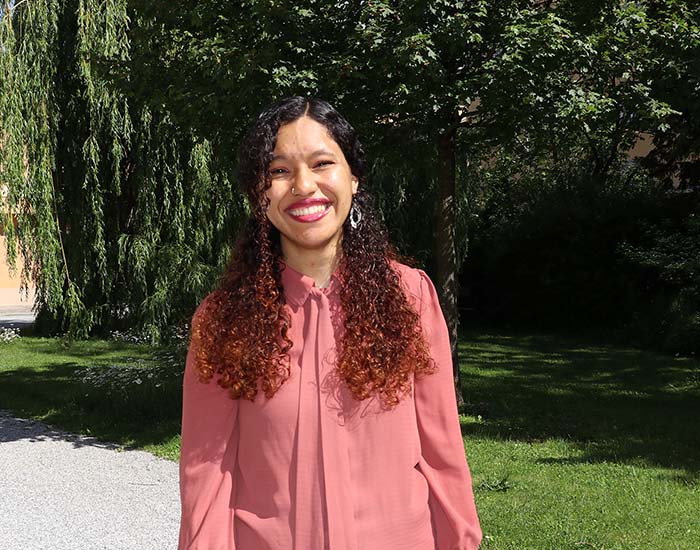
Micely Diaz Espaillat
Currently: Doctoral Student, Department of Political and Cultural Change, Center for Development Research (ZEF), University of Bonn, Germany
Studies at the University of Graz: Graz International Summerschool Seggau (GUSEGG) 2024
When did you attend the Graz International Summer School in Seggau?
I attended the Graz International Summer School in 2024, two years ago, right after returning from my fieldwork in rural settlements around sugarcane plantations in the Dominican Republic, known as bateyes. It was a very intense period, so arriving in Seggau School of Thought was very transformative.
How did you hear about the summer school?
My colleague and friend Wendy Chavez, who attended the program in 2023, told me I absolutely had to apply because it was the best summer school experience she had ever had. She described it as magical and that I would not regret being in a castle, surrounded by brilliant people, while also learning so much. I didn’t hesitate for a second. I immediately started working on my motivation letter, requested recommendation letters, and applied.
What did you take with you?
Honestly, that summer school gave me invaluable things. First of all, beautiful friendships that I still cherish today with cool people who are disruptive, critical, and unafraid to go against the current. I also gained so many meaningful intellectual and personal experiences, including the opportunity to publish an article on anti-Haitianism in the Off Campus: Seggau School of Thought. That alone was an extraordinary take-away.
At the summer school, I presented my poster The Bitterness of Sugarcane, and that experience opened unexpected doors. Thanks to that opportunity, I was later invited by the Aging in Data project at Concordia University to present my research. That is exactly the kind of bridge the program builds.
What I loved most was how holistic the program was. It wasn’t only about critical thinking and academic rigor, but also about interpersonal relationships, debate, and the possibility of sharing your research in a truly interdisciplinary and intercultural environment. I came away not only with real friends and new knowledge, but also with the confidence to share my work with others. It was a truly collaborative space with creative thinking and amazing professors that were available to discuss your work and give feedback to improve it.
What does it mean to you to come back to Graz and to present your work at the Tribuna Conference 2026, within the framework of “50 Years of Iberoamerica” celebrations?
For me, it is a real honor to return to Graz, especially for such an important event as the Tribuna Conference, where so many relevant issues are discussed through a diverse, engaging and intercultural program. I felt incredibly happy when I received the invitation, and the excitement of being here still hasn’t faded. I feel deeply grateful to return to a place full of beautiful memories.
Your presentation is titled “The Architecture of Anti-Haitianism in the Dominican Republic.” For those who might not be familiar with the term: How would you define anti-Haitianism?
Anti-Haitianism refers to hostile attitudes, racist prejudices, and state-sanctioned policies directed against Haitians and their African heritage. It operates economically, politically, socially, and culturally through violence, suspicion, persecution, detention, dehumanization, and the denial of basic rights.
Although my research focuses on the manifestations of Anti-Haitianism in the Dominican Republic, it is actually a broader transnational phenomenon that extends beyond the island itself. While the Dominican state has implemented several discriminatory policies against Haitians and their descendants, anti-Haitian sentiments are also visible in other countries where Haitians migrate or transit, such as Chile, Brazil, Mexico, the Bahamas, the United States, among others. In that sense, anti-Haitianism should not be understood as Dominican exceptionalism, but rather as a transnational phenomenon rooted in shared histories of coloniality, anti-Blackness, racialized labor exploitation, nationalism, and the criminalization of migration.
What originally motivated you to focus your work on racism, social justice, and specifically on anti-Haitianism in the Dominican Republic?
I have always been passionate about social justice. The way racism operates and sustains itself in the Caribbean, a region where anti-Blackness first took shape through the violence of the transatlantic slave trade, raises many questions for me, especially the paradox of neighboring nations with such deeply connected histories existing alongside so much hostility and inequality.
My first encounter with anti-Haitianism dates back to childhood. While taking public transportation to school, I witnessed Haitian passengers being refused entry or forced off vehicles the moment drivers noticed their nationality. It seemed profoundly absurd to me, but as a child, I lacked the tools to intervene. Since then, I have only seen anti-Haitianism deepen. We owe so much to the Haitian people, yet their lives revolve around extremely hard labor, poverty, and mistreatment. These contradictions pushed me to study anti-Haitianism more deeply to understand how hatred, exclusion, and racial hierarchies become normalized within another Afro-descendant yet racist society such as the Dominican Republic.
What are your main research areas of interest?
I really enjoy qualitative research, especially when it focuses on social justice, racism, and labor rights. Anti-Haitianism is probably the broader umbrella of my work, but from there many related issues emerge: access to social security, labor exploitation, statelessness, and the broader realities of the bateyes. I’m particularly interested in understanding the ontological exclusion of those considered subhuman and the way belonging becomes a resistance mechanism in the face of structural racism.
What advice would you give to students and young researchers who want to work on topics like racism, decoloniality, and social change?
I would say that even if your research focuses on a very specific place or community, it is important to understand racism as a global system of domination and exploitation. I believe we always need to look for the connections between the local and the global, and to remain in conversation with others working on similar issues in different contexts whether it is about Palestine, Sudan, Congo, Venezuela, Iran, Cuba, Myanmar, Lebanon, etc., the list is endless, but most importantly, with the communities affected by these issues. I also believe that decoloniality, and therefore decolonial research methods, is fundamentally an ethical principle. We have the responsibility to find creative ways of doing research that do not revictimize people or treat communities as merely ‘objects’ of study. We need to co-create knowledge while being very careful about how we portray people’s realities, and how we acknowledge power differences, constantly reflecting on our positionality and reflexivity.
Furthermore, I believe that research should be a truly collaborative process. We are not the ultimate experts; in many ways, we are learners. The real experts are often those whose lives and bodies carry the lived consequences of racism and other systems of oppression daily. Those caught in a constant struggle for survival, where life itself becomes a battle, rarely have the privilege of writing about it. That is precisely why the privilege of doing research must be exercised through an ethics of action, not of empty words buried in incomprehensible papers locked behind expensive peer-reviewed journals that profit from knowledge while keeping it out of reach from the very communities it concerns. Let’s do research that does not end on the page, but lives in the struggle for social change.