


A. Tomoko Molnár
Currently: Master student in the SPOT – Social Psychology of Transformation joint master’s program, programme with 7 European and Balkan universities
Studies at the University of Graz: Graz International Summer School Seggau (GUSEGG) 2022
Where are you from?
I come from a bicultural background, with roots in Hungary and Japan. I was raised in Hungary, while my extended family currently lives in Japan, I’ve grown up navigating both cultural contexts.
Which university are you currently working at?
I’m currently an Erasmus Mundus scholar in the SPOT – Social Psychology of Transformation joint master’s program. It’s a program across seven European and Balkan universities.
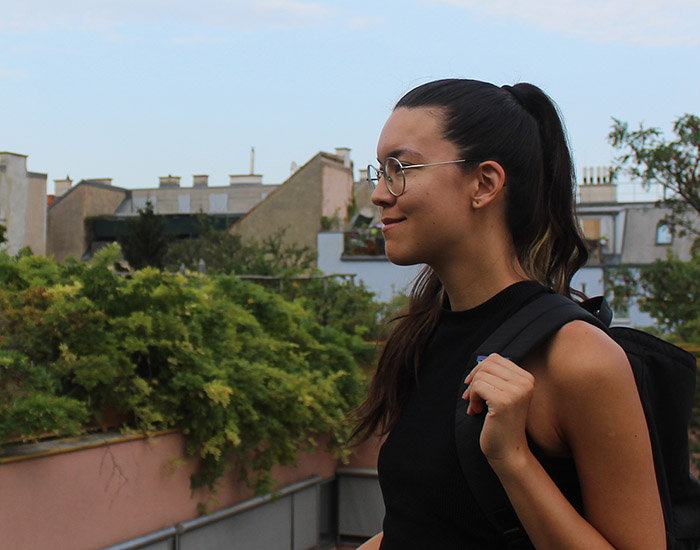
What are you currently working on?
My work sits at the intersection of intersectionality, power, and participation, with a focus on epistemic injustice and relational pedagogies within critical, applied social and environmental psychology. I’m interested in social cohesion at the neighborhood level and how more inclusive, democratic planning and collaboration cultures can be facilitated. I’m currently involved in a participatory housing movement through an NGO, where I explore alternative legal and financial models, as well as the policy and normative frameworks around them. I value working across disciplines, because I think it helps challenge the biases that any one field can have. Applied social psychology is quite problem-oriented. I’m also in the process of defining my master’s thesis topic and preparing for an internship.
When did you take part in the summer school?
I was able to participate in the 2022 cohort, thanks to a CEEPUS scholarship. I attended the Narrative Didactics seminar led by Roberta Maierhofer and Nicole Haring.
What are your memories of your time there?
At that time, I was doing my bachelor’s in psychology in a rather depoliticized and Eurocentric educational environment, so what I appreciated most was the critical, feminist community. I especially valued the intergenerational aspect of the seminar and the wider program, as well as the informal conversations during lunch breaks with people who were not afraid to question things. I also remember the morning mindfulness practices, and also the large tree in the garden where I would sit and meditate sometimes — it felt like it was somehow protecting the space. Looking back, it feels quite rare to encounter that kind of community.
What did you take away from that experience?
What I took away were seeds that, over time, found their way into becoming thinking tools I still apply today, along with friendships that I deeply cherish. The critical lens I was exposed to, together with the intercultural environment.